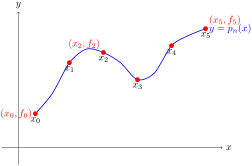
Take the standard basis \(\{1, x, \ldots, x^n\}\) for \(P_n[x]\text{.}\) Then \(p_n(x) \in P_n[x]\) can be written as
\begin{equation*}
p_n(x) = a_0 + a_1 x + \cdots + a_n x^n
\end{equation*}
If
\(p_n(x)\) is the interpolating polynomial, then it must satisfy condition
(10.1.2), so the coefficients
\(a_0, a_1, \ldots, a_n\) must satisfy the system of equations:
\begin{equation}
\begin{cases}
a_0 + a_1 x_0 + \cdots + a_n x_0^n = f_0 \\
a_0 + a_1 x_1 + \cdots + a_n x_1^n = f_1 \\
\quad \vdots \\
a_0 + a_1 x_n + \cdots + a_n x_n^n = f_n
\end{cases}\tag{10.1.3}
\end{equation}
This is a linear system, and its coefficient matrix determinant is the Vandermonde determinant:
\begin{equation*}
V_n(x_0, x_1, \ldots, x_n) = \begin{vmatrix}
1 \amp x_0 \amp \cdots \amp x_0^n \\
1 \amp x_1 \amp \cdots \amp x_1^n \\
\vdots \amp \vdots \amp \amp \vdots \\
1 \amp x_n \amp \cdots \amp x_n^n
\end{vmatrix} = \prod_{i=1}^n \prod_{j=0}^{i-1} (x_i - x_j)
\end{equation*}
Therefore, when the nodes
\(x_0, x_1, \ldots, x_n\) are distinct, we have
\(V_n(x_0, x_1, \ldots, x_n) \neq 0\text{,}\) so the linear system
(10.1.3) has a unique solution. This means there exists a unique polynomial
\(p_n(x) \in P_n[x]\) satisfying condition
(10.1.1).