Chapter 1 System of linear equations

Solving systems of linear equations is a fundamental technique in linear algebra and forms the backbone of many mathematical and scientific applications. By representing a system of equations as a matrix equation, we can utilize powerful matrix operations to analyze and solve complex problems efficiently. This approach not only streamlines computations but also provides deeper insights into the structure and properties of linear systems. Understanding how to manipulate matrices to find solutions enables us to tackle a wide range of challenges in engineering, physics, computer science, and economics, making it an essential skill for anyone studying linear algebra and matrix theory.
Before diving into computational methods, let’s develop a geometric intuition. Every linear equation describes a geometric object—a line in 2D, a plane in 3D, or a hyperplane in higher dimensions. Solving a system means finding where these objects intersect. This geometric perspective transforms abstract algebra into visual understanding!
Consider a \(2 \times 2\) linear system:
\begin{equation*} \begin{aligned} a_1x + b_1y \amp= c_1\\ a_2x + b_2y \amp= c_2 \end{aligned} \end{equation*}
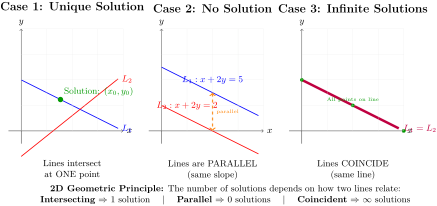
Each equation represents a line in the \(xy\)-plane. Solving the system means finding \((x, y)\) that lies on both lines simultaneously—that is, the intersection point.
Shows three cases: two lines intersecting at one point (unique solution), two parallel lines (no solution), and two coincident lines (infinitely many solutions).
Figure 1.0.1. Three Possibilities for Two Lines in the Plane

Example 1.0.2. Two Lines Intersecting.

Solve the system:
\begin{equation*} \begin{aligned} x + 2y \amp= 4\\ 4x - 5y \amp= 5 \end{aligned} \end{equation*}
Solution.
Geometrically: we’re finding where the line \(x + 2y = 4\) intersects the line \(4x - 5y = 5\text{.}\)
Algebraically: From the first equation, \(x = 4 - 2y\text{.}\) Substituting into the second:
\begin{align*} 4(4-2y) - 5y \amp= 5\\ 16 - 8y - 5y \amp= 5\\ -13y \amp= -11\\ y \amp= \frac{11}{13} \end{align*}
Then \(x = 4 - 2 \cdot \frac{11}{13} = \frac{30}{13}\text{.}\)
Unique solution: \(\left(\frac{30}{13}, \frac{11}{13}\right)\text{.}\) The lines have different slopes, so they must intersect at exactly one point.

When do we get no solutions or infinitely many?
  • No solution: If equations represent parallel but distinct lines (same slope, different intercepts). Example: \(x + 2y = 4\) and \(x + 2y = 2\text{.}\)
  • Infinitely many solutions: If equations represent the same line. Example: \(x + 2y = 4\) and \(2x + 4y = 8\) (second is just 2× first).

Insight 1.0.3. Geometric Insight into Solutions.

The number of solutions to a linear system has geometric meaning:
  • Unique solution: Geometric objects intersect at exactly one point (general position).
  • No solution: Objects are "parallel" or configured so they never all intersect.
  • Infinitely many: Objects overlap more than expected (some equations redundant).
Later, we’ll use matrix methods (row reduction) to determine which case we’re in, without needing to visualize high-dimensional geometry!
Now that we understand the geometric picture, let’s develop algebraic tools to solve these systems systematically and efficiently, regardless of dimension!
