Section 8.1 9.1 Planes in Space and Their Equations

Subsection 8.1.1 Point-Normal Form of a Plane

Definition 8.1.1. Point-Normal Equation of a Plane.

Let \(P_0(x_0,y_0,z_0)\) be a fixed point in space and let \(\mathbf{n}=(A,B,C)\neq \mathbf{0}\) be a normal vector. The plane through \(P_0\) with normal vector \(\mathbf{n}\) is given by
\begin{equation*} A(x-x_0)+B(y-y_0)+C(z-z_0)=0. \end{equation*}
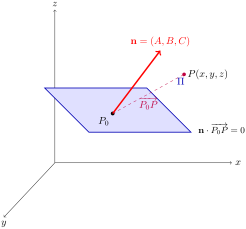
described in detail following the image
A plane in space with a marked point on the plane and a normal vector perpendicular to the plane.
Figure 8.1.2. Geometric Meaning of the Point-Normal Equation

Proof.

By geometry, \(P\) is on the plane exactly when the displacement vector
\begin{equation*} \overrightarrow{P_0P}=(x-x_0,\,y-y_0,\,z-z_0) \end{equation*}
is perpendicular to the normal vector \(\mathbf{n}\text{.}\) By the dot-product criterion for orthogonality,
\begin{equation*} \mathbf{n}\cdot \overrightarrow{P_0P}=0. \end{equation*}
Therefore,
\begin{equation*} (A,B,C)\cdot(x-x_0,\,y-y_0,\,z-z_0)=0, \end{equation*}
which is exactly
\begin{equation*} A(x-x_0)+B(y-y_0)+C(z-z_0)=0. \end{equation*}
Example 8.1.4. Building a Plane Equation from a Point and a Normal Vector.

Find the equation of the plane through \(P_0(1,-2,3)\) with normal vector \(\mathbf{n}=(2,-1,4)\text{.}\)
Solution.
\begin{equation*} 2(x-1)-1(y+2)+4(z-3)=0. \end{equation*}
Simplifying,
\begin{equation*} 2x-y+4z-16=0. \end{equation*}

Subsection 8.1.2 General Form and Geometric Meaning of Coefficients

Definition 8.1.5. General Form of a Plane.

Every plane in space can be written as
\begin{equation*} Ax+By+Cz+D=0, \end{equation*}
where \((A,B,C)\neq (0,0,0)\text{.}\) The vector \((A,B,C)\) is a normal vector to the plane.

Insight 8.1.6. What Do the Coefficients Mean?

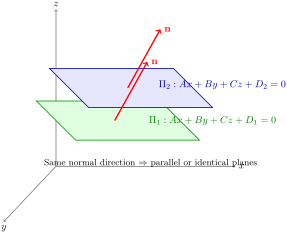
In \(Ax+By+Cz+D=0\text{,}\) the coefficients \(A,B,C\) determine the direction of the normal vector, so they determine the orientation of the plane. The constant term \(D\) shifts the plane along the normal direction.
If two planes have proportional triples \((A,B,C)\text{,}\) then their normals are parallel, so the planes are parallel or identical.
described in detail following the image
Two parallel planes in space with aligned normal vectors to highlight coefficient proportionality in their equations.
Figure 8.1.7. Parallel Planes Share Parallel Normal Vectors

Subsection 8.1.3 Intercept Form of a Plane

Proof.

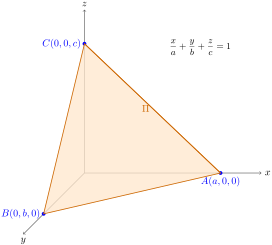
The intercept points are \(A(a,0,0)\text{,}\) \(B(0,b,0)\text{,}\) and \(C(0,0,c)\text{.}\) Substituting each into a general linear equation shows that the coefficients can be scaled to obtain
\begin{equation*} \frac{x}{a}+\frac{y}{b}+\frac{z}{c}=1. \end{equation*}
described in detail following the image
A plane cutting the x-, y-, and z-axes at three intercept points, visualizing the intercept form equation.
Figure 8.1.9. Plane Determined by Three Axis Intercepts

Example 8.1.10. Converting General Form to Intercept Form.

Convert \(2x+3y+6z-12=0\) to intercept form and identify its axis intercepts.
Solution.
Rewrite as \(2x+3y+6z=12\text{,}\) then divide by \(12\text{:}\)
\begin{equation*} \frac{x}{6}+\frac{y}{4}+\frac{z}{2}=1. \end{equation*}
Hence the intercepts are \((6,0,0)\text{,}\) \((0,4,0)\text{,}\) and \((0,0,2)\text{.}\)

Checkpoint 8.1.11. Practice Exercises.

(a)
Find the plane through \((2,1,-1)\) with normal vector \((3,-2,5)\text{.}\)
(b)
Determine whether the planes \(2x-y+z-3=0\) and \(4x-2y+2z+1=0\) are parallel or identical.
(c)
Find the intercept form of \(3x+2y+z=6\text{.}\)