Section 8.2 9.2 Lines in Space and Their Equations

Subsection 8.2.1 Parametric Equation of a Line

Definition 8.2.1. Parametric Form of a Spatial Line.

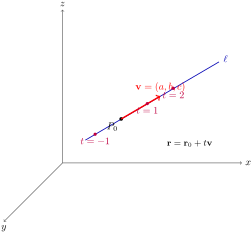
A line through \(P_0(x_0,y_0,z_0)\) with direction vector \(\mathbf{v}=(a,b,c)\neq\mathbf{0}\) is
\begin{equation*} \begin{cases} x=x_0+at,\\ y=y_0+bt,\\ z=z_0+ct, \end{cases} \qquad t\in\mathbb{R}. \end{equation*}
described in detail following the image
A line passing through a fixed point with a direction vector, showing points generated by varying the parameter.
Figure 8.2.2. Line as a Point Plus a Direction Multiple

Example 8.2.3. Writing a Parametric Equation.

Write parametric equations for the line through \((1,-2,0)\) parallel to \((2,1,-3)\text{.}\)
Solution.
\begin{equation*} \begin{cases} x=1+2t,\\ y=-2+t,\\ z=-3t. \end{cases} \end{equation*}

Subsection 8.2.2 Symmetric (Point-Direction) Form

Proof.

From the parametric equations, each fraction equals the same parameter \(t\text{.}\) Conversely, if all three fractions equal a common value \(t\text{,}\) then the parametric equations follow immediately.

Example 8.2.5. Converting Parametric to Symmetric Form.

Convert
\begin{equation*} x=3+2t,\quad y=1-t,\quad z=-4+5t \end{equation*}
to symmetric form.
Solution.
We obtain
\begin{equation*} \frac{x-3}{2}=\frac{y-1}{-1}=\frac{z+4}{5}. \end{equation*}

Subsection 8.2.3 General Form: A Line as Intersection of Two Planes

Definition 8.2.6. General Form of a Spatial Line.

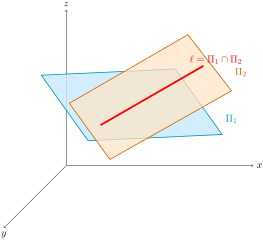
A line can be represented as the intersection of two non-parallel planes:
\begin{equation*} \ell: \begin{cases} A_1x+B_1y+C_1z+D_1=0,\\ A_2x+B_2y+C_2z+D_2=0. \end{cases} \end{equation*}
described in detail following the image
Two non-parallel planes intersecting along a common line in three-dimensional space.
Figure 8.2.7. A Line Formed by Intersecting Two Planes

Example 8.2.8. From Two-Plane Form to Parametric Form (Using RREF).

Convert
\begin{equation*} \begin{cases} x+y+z=2,\\ 2x-y+z=1 \end{cases} \end{equation*}
to a parametric equation of the line.
Solution.
The augmented matrix for the system is
\begin{equation*} \left[ \begin{array}{ccc|c} 1 \amp 1 \amp 1 \amp 2\\ 2 \amp -1 \amp 1 \amp 1 \end{array} \right]. \end{equation*}
Row reducing to reduced row echelon form gives
\begin{equation*} \left[ \begin{array}{ccc|c} 1 \amp 0 \amp \frac{2}{3} \amp 1\\ 0 \amp 1 \amp \frac{1}{3} \amp 1 \end{array} \right]. \end{equation*}
So
\begin{equation*} x=1-\frac{2}{3}z,\quad y=1-\frac{1}{3}z. \end{equation*}
Let \(z=3t\text{.}\) Then
\begin{equation*} x=1-2t,\quad y=1-t,\quad z=3t. \end{equation*}
Therefore,
\begin{equation*} \begin{cases} x=1-2t,\\ y=1-t,\\ z=3t, \end{cases} \quad t\in\mathbb{R}. \end{equation*}
Checkpoint 8.2.9. Practice Exercises.

(a)
Write parametric and symmetric equations for the line through \((-1,2,3)\) with direction \((4,-2,1)\text{.}\)
(b)
Convert \(\frac{x-2}{3}=\frac{y+1}{-2}=\frac{z}{5}\) to parametric form.
(c)
Express the line given by \(x=2+t,\ y=1-2t,\ z=3+4t\) as the intersection of two planes.