
Section 5.1 Euclidean Space

What is Euclidean \(n\)-space?
Euclidean \(n\)-space is the vector space \(\mathbb{R}^n\) equipped with a dot product. This additional structure allows us to introduce geometric concepts like length, distance, and angle—extending our intuition from 2D and 3D geometry to higher dimensions.
\begin{equation*} \text{Vector Space } \mathbb{R}^n + \text{Dot Product} = \text{Euclidean } n\text{-space} \end{equation*}
Why Start with Euclidean Space?
  • Concrete Foundation: Euclidean \(n\)-space provides a familiar, computational setting where we can develop geometric intuition. The dot product \(\mathbf{u} \cdot \mathbf{v} = u_1v_1 + u_2v_2 + \cdots + u_nv_n\) is easy to compute and visualize (especially in \(\mathbb{R}^2\) and \(\mathbb{R}^3\)).
  • Prototype for Abstract Inner Products: The properties of the dot product serve as a model for defining inner products on other vector spaces. Once we understand these properties in \(\mathbb{R}^n\text{,}\) we can generalize them to spaces of polynomials, functions, and matrices.
  • Essential for Applications: Most practical applications—from physics to machine learning—work with vectors in \(\mathbb{R}^n\text{.}\) Understanding the geometric structure of Euclidean space is essential for these applications.
The Power of the Dot Product:
The dot product is more than just a way to multiply vectors. It encodes fundamental geometric information:
  • Length: \(\|\mathbf{v}\| = \sqrt{\mathbf{v} \cdot \mathbf{v}}\)
  • Distance: \(d(\mathbf{u}, \mathbf{v}) = \|\mathbf{u} - \mathbf{v}\|\)
  • Angle: \(\cos\theta = \frac{\mathbf{u} \cdot \mathbf{v}}{\|\mathbf{u}\|\|\mathbf{v}\|}\)
  • Orthogonality: \(\mathbf{u} \perp \mathbf{v}\) if and only if \(\mathbf{u} \cdot \mathbf{v} = 0\)
These geometric concepts will be the foundation for everything we do in this chapter, from orthogonal projections to least squares approximation.

Subsection 5.1.1 Dot product in \(\mathbb{R}^{n}\)

Why Define the Dot Product?
The dot product is the fundamental operation that connects algebra with geometry. While vector addition and scalar multiplication give us an algebraic structure, the dot product provides geometric structure—it allows us to measure and compare vectors in meaningful ways.

Dot product in \(\mathbb{R}^{n}\).

The dot product of \(\mathbf{u}=\left(u_{1}, u_{2}, \ldots, u_{n}\right)\) and \(\mathbf{v}=\left(v_{1}, v_{2}, \ldots, v_{n}\right)\) is the scalar quantity
\begin{equation*} \mathbf{u} \cdot \mathbf{v}=u_{1} v_{1}+u_{2} v_{2}+\cdots+u_{n} v_{n} \end{equation*}
Key Observation: The dot product takes two vectors as input and produces a scalar (real number) as output. This scalar contains geometric information about the relationship between the two vectors.
Important Properties of the Dot Product:
If \(\mathbf{u}, \mathbf{v}\text{,}\) and \(\mathbf{w}\) are vectors in \(\mathbb{R}^n\) and \(c\) is a scalar, then:
  1. \(\mathbf{u} \cdot \mathbf{v} = \mathbf{v} \cdot \mathbf{u}\) (Commutativity)
  2. \(\mathbf{u} \cdot (\mathbf{v} + \mathbf{w}) = \mathbf{u} \cdot \mathbf{v} + \mathbf{u} \cdot \mathbf{w}\) (Distributivity)
  3. \(c(\mathbf{u} \cdot \mathbf{v}) = (c\mathbf{u}) \cdot \mathbf{v} = \mathbf{u} \cdot (c\mathbf{v})\) (Scalar Multiplication)
  4. \(\mathbf{v} \cdot \mathbf{v} \geq 0\text{,}\) and \(\mathbf{v} \cdot \mathbf{v} = 0\) if and only if \(\mathbf{v} = \mathbf{0}\) (Positive Definiteness)
These four properties are so important that we will use them as axioms when we define inner products on abstract vector spaces later in this chapter.

Example 5.1.1.

Let \(\mathbf{u}=(1,2,0,-3)\) and \(\mathbf{v}=(3,-2,4,2)\text{.}\) Find \(\mathbf{u}\cdot \mathbf{v}\text{.}\)

Exercises Exercises

1.
Let \(\mathbf{u}=(1,0,-3)\) and \(\mathbf{v}=(3,2,1)\text{.}\)
  1. Find \(\mathbf{u}\cdot \mathbf{v}\text{.}\)
  2. Find a nonzero vector \(\mathbf{w}\) such that \(\mathbf{w}\cdot \mathbf{u}=0\) and \(\mathbf{w}\cdot \mathbf{v}=0\text{.}\)

Subsection 5.1.2 Length

Definition 5.1.3.

The length , or norm, of a vector \(\mathbf{v}=\left(v_{1}, v_{2}, \ldots, v_{n}\right)\) in \(\mathbb{R}^{n}\) is
\begin{equation*} \|\mathbf{v}\|=\sqrt{\mathbf{v} \cdot \mathbf{v}}=\sqrt{v_{1}^{2}+v_{2}^{2}+\cdots+v_{n}^{2}} \end{equation*}
If \(\|\mathbf{v}\|=1\text{,}\) then the vector \(\mathbf{v}\) is called a unit vector.
If \(\mathbf{v}\) is a nonzero vector in \(\mathbb{R}^{n}\text{,}\) then the vector
\begin{equation*} \mathbf{u}=\frac{\mathbf{v}}{\|\mathbf{v}\|} \end{equation*}
has length 1 and has the same direction as \(\mathbf{v}\text{.}\) This vector \(\mathbf{u}\) is the unit vector in the direction of \(\mathbf{v}\text{.}\)
Find the unit vector in the opposite direction of \(\mathbf{v}=(3,-1,2)\text{.}\)

Subsection 5.1.3 Angle

Definition 5.1.5.

  1. The angle \(\theta\) between two nonzero vectors in \(\mathbb{R}^{n}\) is defined as
    \begin{equation*} \theta=\arccos\left(\frac{\mathbf{u} \cdot \mathbf{v}}{\|\mathbf{u}\|\|\mathbf{v}\|}\right) \end{equation*}
  2. Two vectors \(\mathbf{u}\) and \(\mathbf{v}\) in \(\mathbb{R}^{n}\) are called orthogonal if \(\mathbf{u} \cdot \mathbf{v}=0.\)
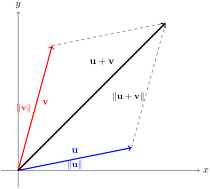
A diagram showing vectors u, v, and u+v forming a triangle, illustrating that the length of u+v is less than or equal to the sum of lengths of u and v.
Figure 5.1.7. Geometric Illustration of the Triangle Inequality
The name "triangle inequality" comes from the geometric interpretation: in a triangle formed by vectors \(\mathbf{u}\text{,}\) \(\mathbf{v}\text{,}\) and \(\mathbf{u}+\mathbf{v}\text{,}\) the length of any side is at most the sum of the lengths of the other two sides. Equality holds when \(\mathbf{u}\) and \(\mathbf{v}\) point in the same direction.

Example 5.1.9.

Let \(\mathbf{u}=(1,2,0,-3)\) and \(\mathbf{v}=(3,-2,4,2)\text{.}\) Find the angle between \(\mathbf{u}\) and \(\mathbf{v}\text{.}\)
Subsection 5.1.4 Distance

The distance between two vectors \(\mathbf{u}\) and \(\mathbf{v}\) in \(\mathbb{R}^{n}\) is
\begin{equation*} d(\mathbf{u}, \mathbf{v})=\|\mathbf{u}-\mathbf{v}\| . \end{equation*}

Example 5.1.10.

Let \(\mathbf{u}=(1,2,0,-3)\) and \(\mathbf{v}=(3,-2,4,2)\text{.}\) Find the distance between \(\mathbf{u}\) and \(\mathbf{v}\text{.}\)

Subsection 5.1.5 Cross Product

The cross product only works for the vectors in \(\mathbb{R}^{3}\)

Example 5.1.11.

Let \(\mathbf{u}=(1,0,-3)\) and \(\mathbf{v}=(3,2,1)\text{.}\) Find the \(\mathbf{u}\times \mathbf{v}\text{,}\) which is a vector orthogonal to both \(\mathbf{u}\) and \(\mathbf{v}\text{.}\)
