Section 8.4 9.4 Angles and Distance Formulas in Space

Subsection 8.4.1 Angle Between a Line and a Plane

Proof.

Let \(\varphi\) be the angle between \(\mathbf{v}\) and \(\mathbf{n}\text{.}\) Since the line-plane angle is complementary to this angle, \(\theta=\left|\frac{\pi}{2}-\varphi\right|\text{.}\) Therefore
\begin{equation*} \sin\theta=|\cos\varphi|=\frac{|\mathbf{v}\cdot\mathbf{n}|}{\|\mathbf{v}\|\,\|\mathbf{n}\|}. \end{equation*}
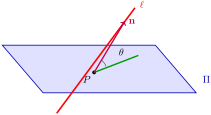
described in detail following the image
A line crossing a plane with the acute angle marked between the line and its projection on the plane.
Figure 8.4.2. Angle Between a Line and a Plane

Subsection 8.4.2 Angle Between Two Planes

Example 8.4.4. Computing a Plane-Plane Angle.

Find the angle between planes
\begin{equation*} \Pi_1: x+2y-z+1=0,\qquad \Pi_2: 2x-y+2z-3=0. \end{equation*}
Solution.
Normal vectors are \(\mathbf{n}_1=(1,2,-1)\) and \(\mathbf{n}_2=(2,-1,2)\text{.}\) Then
\begin{equation*} \mathbf{n}_1\cdot\mathbf{n}_2=1\cdot2+2\cdot(-1)+(-1)\cdot2=-2. \end{equation*}
So
\begin{equation*} \cos\phi=\frac{|-2|}{\sqrt{1^2+2^2+(-1)^2}\,\sqrt{2^2+(-1)^2+2^2}}=\frac{2}{\sqrt{6}\cdot3}=\frac{2}{3\sqrt{6}}. \end{equation*}

Subsection 8.4.3 Distance Formulas in Space

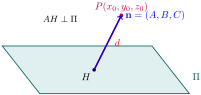
described in detail following the image
A point above a plane with a perpendicular segment to the plane representing the shortest distance.
Figure 8.4.7. Distance from a Point to a Plane Along the Normal Direction

Example 8.4.8. Distance from a Point to a Plane.

Find the distance from \(P(2,-1,3)\) to the plane \(2x-y+2z-4=0\text{.}\)
Solution.
\begin{equation*} d=\frac{|2(2)-(-1)+2(3)-4|}{\sqrt{2^2+(-1)^2+2^2}}=\frac{|4+1+6-4|}{3}=\frac{7}{3}. \end{equation*}

Checkpoint 8.4.9. Practice Exercises.

(a)
Find the angle between the line with direction \((1,2,2)\) and the plane \(x-y+z=3\text{.}\)
(b)
Find the angle between planes \(x+y+z=0\) and \(x-2y+2z=1\text{.}\)
(c)
Find the distance from \((1,2,-1)\) to \(3x-2y+6z+4=0\text{.}\)
(d)
Compute the distance between skew lines \(\ell_1:(x,y,z)=(0,0,0)+t(1,1,0)\) and \(\ell_2:(x,y,z)=(1,0,1)+s(0,1,1)\text{.}\)