Section 8.3 9.3 Position Relations of Lines and Planes

Subsection 8.3.1 Plane-Plane Relations

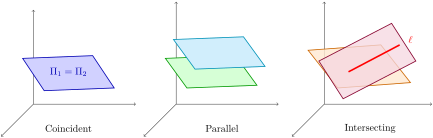
described in detail following the image
Three side-by-side sketches showing coincident planes, parallel planes, and intersecting planes.
Figure 8.3.2. Three Plane-Plane Cases: Coincident, Parallel, Intersecting

Subsection 8.3.2 Line-Line Relations

Definition 8.3.3. Parallel, Intersecting, and Skew Lines.

For lines
\begin{equation*} \ell_1:\mathbf{r}=\mathbf{r}_1+t\mathbf{v}_1,\quad \ell_2:\mathbf{r}=\mathbf{r}_2+s\mathbf{v}_2, \end{equation*}
we classify as follows:
  • Parallel if \(\mathbf{v}_1\parallel\mathbf{v}_2\text{.}\)
  • Intersecting if there exist \(t,s\) such that \(\mathbf{r}_1+t\mathbf{v}_1=\mathbf{r}_2+s\mathbf{v}_2\text{.}\)
  • Skew if they are not parallel and do not intersect.

Example 8.3.4. Testing Intersection of Two Lines (Using RREF).

Determine the relation between
\begin{equation*} \ell_1:(x,y,z)=(1,0,2)+t(2,-1,1), \end{equation*}
\begin{equation*} \ell_2:(x,y,z)=(3,-1,1)+s(1,1,2). \end{equation*}
Solution.
Set coordinates equal:
\begin{equation*} \begin{cases} 1+2t=3+s,\\ -t=-1+s,\\ 2+t=1+2s. \end{cases} \end{equation*}
The augmented matrix is
\begin{equation*} \left[ \begin{array}{cc|c} 2 \amp -1 \amp 2\\ -1 \amp -1 \amp -1\\ 1 \amp -2 \amp -1 \end{array} \right]. \end{equation*}
Row reducing to reduced row echelon form gives
\begin{equation*} \left[ \begin{array}{cc|c} 1 \amp 0 \amp 1\\ 0 \amp 1 \amp 0\\ 0 \amp 0 \amp 0 \end{array} \right]. \end{equation*}
So \(t=1\text{,}\) \(s=0\text{.}\) Therefore the lines intersect at
\begin{equation*} (3,-1,3). \end{equation*}
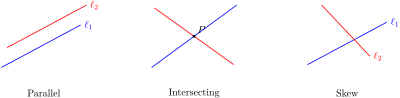
described in detail following the image
Three side-by-side diagrams showing the three possible positional relations of two lines in 3D.
Figure 8.3.5. Parallel, Intersecting, and Skew Lines in Space

Subsection 8.3.3 Line-Plane Relations

Checkpoint 8.3.7. Practice Exercises.

(a)
Classify the relation between \(x+y+z=1\) and \(2x+2y+2z=2\text{.}\)
(b)
Classify the relation between \(\ell_1:(x,y,z)=(0,1,2)+t(1,1,0)\) and \(\ell_2:(x,y,z)=(1,0,3)+s(2,2,0)\text{.}\)
(c)
Determine whether \(\ell:(x,y,z)=(1,-1,2)+t(2,1,3)\) is parallel to, contained in, or intersecting the plane \(x-2y+z-5=0\text{.}\)