
Section 5.2 Orthogonal Projection

Why Are Orthogonal Projections So Important?
Orthogonal projection is one of the most fundamental operations in linear algebra, with applications ranging from computer graphics to machine learning. The key idea is simple but powerful: given a vector and a subspace, find the vector in the subspace that is \"closest\" to the given vector.
The Closest Point Problem:
Suppose you have a vector \(\mathbf{b}\) and a subspace \(W\text{.}\) What vector \(\mathbf{w} \in W\) minimizes the distance \(\|\mathbf{b} - \mathbf{w}\|\text{?}\)
Answer: The orthogonal projection of \(\mathbf{b}\) onto \(W\text{.}\) Geometrically, we \"drop a perpendicular\" from \(\mathbf{b}\) to \(W\text{.}\)
Why This Matters:
  • Best Approximation: If we can’t represent \(\mathbf{b}\) exactly in \(W\text{,}\) the projection gives the best approximation.
  • Least Squares: Solving \(A\mathbf{x} = \mathbf{b}\) when there’s no exact solution means projecting \(\mathbf{b}\) onto the column space of \(A\text{.}\)
  • Data Compression: Projecting high-dimensional data onto lower-dimensional subspaces (PCA) preserves maximum information.
  • Computer Graphics: Projecting 3D objects onto 2D screens, computing shadows, and finding closest points on surfaces.
The Power of Orthogonal Bases:
Computing projections is much simpler when we have an orthogonal (or better, orthonormal) basis for the subspace. This motivates the Gram-Schmidt process, which converts any basis into an orthonormal one.

Subsection 5.2.1 Orthogonal and Orthonormal Sets

Why Study Orthogonal Sets?
Orthogonal vectors represent independent, perpendicular directions. Working with orthogonal bases simplifies many computations:
  • Projections have simple formulas (no matrix inverses needed!)
  • Coordinates are easy to compute (just take inner products)
  • Orthogonal matrices preserve lengths and angles
  • Many numerical algorithms are more stable with orthogonal bases

Definitions of Orthogonal and Orthonormal.

A set \(S=\{v_1,v_2,\ldots,v_m\}\) of vectors in \(\mathbb{R}^{n}\) is orthogonal when every pair of vectors in \(S\) is orthogonal. That is, \(v_i\cdot v_j=0\) for all \(1\leq i\neq j\leq m\text{.}\)
If, in addition, each vector in the set is a unit vector, then \(S\) is orthonormal.
Key Property: Any orthogonal set of nonzero vectors is linearly independent. This is because if \(c_1\mathbf{v}_1 + c_2\mathbf{v}_2 + \cdots + c_m\mathbf{v}_m = \mathbf{0}\text{,}\) taking the dot product with \(\mathbf{v}_i\) gives \(c_i\|\mathbf{v}_i\|^2 = 0\text{,}\) so \(c_i = 0\text{.}\)
Example 5.2.1.

Show that the set \(S\) below is an orthogonal set of \(\mathbb{R}^{4}\text{.}\)
\begin{equation*} S=\{(2,3,2,-2),(1,0,0,1),(-1,0,2,1),(-1,2,-1,1)\} \end{equation*}
One can check \(S\) is orthogonal for every pair of vectors. You may answer this by matrix multiplication.
Looking Ahead: Since this is an orthogonal set of 4 nonzero vectors in \(\mathbb{R}^4\text{,}\) it is linearly independent and therefore forms a basis. In the next section, we’ll learn the Gram-Schmidt Process, which converts any basis into an orthonormal basis.

Subsection 5.2.2 Orthogonal Projection

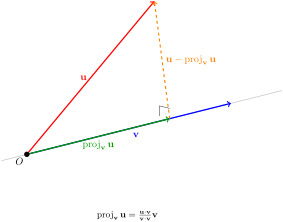
Let \(\mathbf{u}\) and \(\mathbf{v}\) be vectors in \(\mathbb{R}^{n}\) such that \(\mathbf{v} \neq \mathbf{0}\text{.}\) Then the orthogonal projection of \(\mathbf{u}\) onto \(\mathbf{v}\) is the vector \(k\mathbf{v}\) (\(k\in \mathbb{R}\)) such that \(\|\mathbf{u}-k\mathbf{v}\|\) attains minimum, denoted by \(\operatorname{proj}_{\mathbf{v}} \mathbf{u}\text{.}\)
A diagram showing vector u decomposed into its projection onto v and the perpendicular component.
Figure 5.2.3. Orthogonal Projection of \(\mathbf{u}\) onto \(\mathbf{v}\)
Key geometric insight: The projection \(\operatorname{proj}_\mathbf{v}\mathbf{u}\) is the component of \(\mathbf{u}\) in the direction of \(\mathbf{v}\text{.}\) The vector \(\mathbf{u} - \operatorname{proj}_\mathbf{v}\mathbf{u}\) (shown in dashed orange) is perpendicular to \(\mathbf{v}\text{,}\) which is why this is called an "orthogonal" projection. This decomposition \(\mathbf{u} = \operatorname{proj}_\mathbf{v}\mathbf{u} + (\mathbf{u} - \operatorname{proj}_\mathbf{v}\mathbf{u})\) splits \(\mathbf{u}\) into parallel and perpendicular components relative to \(\mathbf{v}\text{.}\)
Figure 5.2.4. Given a nonzero vector \(\mathbf{w}\) and a vector \(\mathbf{b}\text{,}\) the orthogonal projection of vector \(\mathbf{b}\) on \(w\) is the vector \(\widehat{\mathbf{b}}\text{.}\)
Discussion: Describe the relation between the vector \(\mathbf{b}-\widehat{\mathbf{b}}\) and the vector \(\mathbf{w}\text{.}\)
There is a great observation if the basis is orthonormal.

Proof.

It follows from Proposition 5.2.5 that
\begin{align*} \hat{w} \amp= (w\cdot v_1)~v_1 + (w\cdot v_2)~v_2 + \cdots + (w\cdot v_m)~v_m\\ \amp = [v_1\, v_2\, \ldots\, v_m]\left[\begin{array}{c} w\cdot v_1\\ w\cdot v_2\\ \ddots \\ w\cdot v_m \end{array}\right]\\ \amp = [v_1\, v_2\, \ldots\, v_m]\left[\begin{array}{c} v_1\cdot w\\ v_2\cdot w\\ \ddots \\ v_m\cdot w \end{array}\right]\\ \amp = [v_1\, v_2\, \ldots\, v_m]\left[\begin{array}{c} v_1^{T}w\\ v_2^{T}w\\ \ddots \\ v_m^{T} w \end{array}\right]\\ \amp = [v_1\, v_2\, \ldots\, v_m]\left[\begin{array}{c} v_1^{T}\\ v_2^{T}\\ \ddots \\ v_m^{T} \end{array}\right]w\\ \amp=\left(QQ^{T}\right)(w) \end{align*}

